Fresno Canal Bridge Replacement on McKinley Avenue
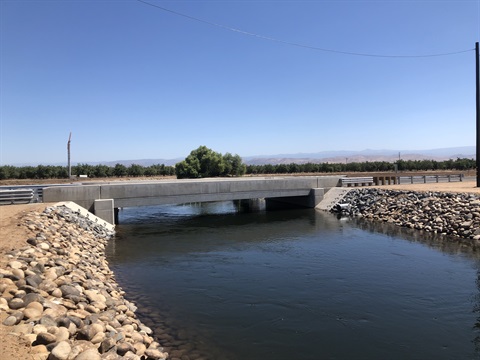
The Fresno Canal Bridge at East McKinley Avenue is located in the County of Fresno, east of Academy Avenue, near the city of Sanger. Constructed in 1939 and widened in 1970, the existing two-span bridge was approximately 48’ long and 24’ wide, andaccommodated two travel lanes with no shoulders. The existing bridge had a sufficiency rating of 37.4 out of 100 and was flagged structurally deficient due to its deteriorating timber superstructure and was load posted for less than highway legal loads.
The low sufficiency rating and identified structural deficiencies qualified this bridge for replacement using Highway Bridge Program funds. Specific requirements imposed by the Fresno Irrigation District (FID), who owns and maintains the canal, were considered in the design of the bridge replacement, including meeting freeboard requirements, maintaining flows during construction, and reconstructing canal access roads.
The $1.5M project included construction of a 62 ft. long clear-span precast/prestressed voided slab bridge and approximately 500 ft. of approach roadway. It also included realignment of the canal access roads at all four corners of the bridge to accommodate new guardrails, construction of full concrete channel lining under the bridge, and relocation of a communication line located on the existing bridge.
The new bridge and approach roadway were constructed to meet AASHTO standards for lane and shoulder widths, with two 12 ft. lanes and 4 ft. shoulders. The new bridge incorporates a composite concrete deck which improves its structural performance by tying adjacent slab units together to allow for better load distribution. This also reduces maintenance costs since the concrete deck will have a 75-year design life, whereas asphalt typically only has a 20-year design life.
BRIDGE DESIGN & CONSTRUCTION
In addition to addressing all structural deficiencies, the project also improved channel hydraulics. The existing bridge abutments had been located inside the channel, interrupting the trapezoid of flow, resulting in hydraulic inefficiencies and scour issues.
The new bridge is approximately 10 ft. longer than the existing bridge and removes the pinch point in the canal, thereby increasing flow capacity and alleviating scour at the abutments. At the request of the project team, FID agreed to maintain existing freeboard conditions, which was somewhat less than their standard freeboard requirement. The project was constructed with a minimal raise in profile grade resulting in negligible fill impacts and a smaller overall project footprint.
The bridge crosses Fresno Canal No. 3, which is one of FID’s main canals used to supply irrigation water to its constituents. Outside of the irrigation season, the canal is also used for flood control purposes, to recharge groundwater and to divert surface water to water treatment facilities for drinking water. Because water runs in the canal year around, the timing of certain construction activities was critical. The optimal time for work within the channel was between September and November. A single span precast bridge was selected to allow for an accelerated construction schedule that satisfied FID’s in-channel work windows. The short, two-month window where flows were lowest was used to construct a temporary canal bypass, demolish the existing bridge, construct new concrete abutments and full concrete channel lining, and remove the temporary canal bypass. From that point, all construction could occur from outside the channel, including placement of precast voided slabs, construction of the cast-in-place concrete deck and barriers, and finishing of approach roadway and canal access roads.
The use of precast to accelerate the construction schedule was also important to minimize disruption to traffic. The County opted to close the road in order to construct the bridge along its existing alignment in a single construction phase. In addition to reducing project costs, closing the road during construction also improves public safety. Construction was completed and the bridge opened in January 2021. This project was fully funded through the HBP program.
CHALLENGES
Replacement of this load posted bridge was prioritized by the County to improve public safety. In addition to addressing the structural deficiencies and improving the narrow bridge deck, the project also improved channel hydraulics. The project required extensive coordination with FID to satisfy their design requirements and to establish a timeframe for construction. The project team was diligent in selecting a precast bridge type that allowed for an accelerated construction schedule to meet FID’s short in-channel work windows. In addition, channel flows were maintained throughout construction with the use of a temporary canal bypass consisting of pipes placed through earth berms constructed upstream and downstream of the bridge. The temporary canal bypass was designed by the project team, approved by FID, permitted through the regulatory agencies, and incorporated into the construction documents for bidding purposes to help expedite construction.
In addition to meeting County and FID standards, since the project was funded through the Highway Bridge Program, the project also had to be approved through Caltrans and satisfy their many requirements. The result of the coordination effort by the project team during the design phase was a project that was fully funded, that improved conditions for all stakeholders and which finished construction ahead of schedule with no major issues.
During design, coordination with FID was very important to meet their design requirements and construction windows. The full concrete channel lining required by FID as a condition of their encroachment permit posed a particular challenge since water is present in the canal year around. The temporary canal bypass designed by the project team consisted of a single pipe running through the project site and penetrating earth berms upstream and downstream of the bridge. To prevent having to move the pipe around or work underneath a suspended pipe to complete the channel lining, the contractor elected to redesign the canal bypass to route flows behind the abutment so that no pipe was placed in the channel. The project team worked quickly to get the revised temporary canal bypass approved and constructed.
SPECIAL RELATIONSHIPS
Special relationships were generated between TRC and project stakeholders, Fresno County and Fresno Irrigation District. TRC and Fresno County worked together as a design team, with the County completing several aspects of the project, including Roadway Design, Environmental, Right-of-Way, Utility Coordination, and Construction Management. TRC competed Bridge Design and Structure Hydraulics, as well as Geotechnical Engineering with the help of subconsultant, Kleinfelder. Close coordination and a good working relationship between TRC and the County were required to prepare a cohesive set of contract documents. TRC also developed a good relationship with FID while seeking their approval on structure hydraulics and bridge and channel improvements.
ACCOLADES RECEIVED
2021 ASCE Fresno Section Awards – Outstanding Small Project
2021 ASCE San Francisco Section Awards – Outstanding Small Project
2021 APWA Fresno Chapter Awards - Outstanding Structural Engineering Project
Construction was completed in January 2021 with a final cost of $1,494,459.